Corrective Eye Surgery – A Complete Guide
Corrective eye surgery has transformed modern eye care, offering millions of people freedom from glasses and contact lenses. With the advancement of medical technology, procedures such as LASIK, PRK, LASEK, SMILE, and implantable lenses have become safe, effective, and widely accessible. People who once relied heavily on corrective eyewear can now enjoy clear vision with minimal dependence on external aids.
This detailed guide explores everything you need to know about corrective eye surgery: the different procedures, how they work, eligibility, preparation, recovery, risks, long-term outcomes, and costs in India. Whether you are considering eye surgery for the first time or simply want to learn more, this comprehensive article provides the clarity you need.
Overview - Corrective Eye Surgery
Corrective eye surgery refers to a group of procedures designed to improve or restore vision by reshaping the cornea or implanting lenses. The goal is to correct common refractive errors such as:
- Myopia (Nearsightedness): Difficulty seeing distant objects clearly.
- Hyperopia (Farsightedness): Trouble focusing on nearby objects.
- Astigmatism: Blurred vision caused by an irregularly shaped cornea.
- Presbyopia: Age-related difficulty in focusing on close-up tasks, usually after 40.
Instead of relying on glasses or contacts, these surgeries correct the structural issues of the eye itself, providing long-term or permanent vision correction.
Evolution of Corrective Eye Surgery
For centuries, people with poor eyesight had only glasses as a solution. Contact lenses came later, offering more flexibility, but both options required ongoing maintenance. The desire for a permanent fix drove medical innovation.
- In the 1940s, radial keratotomy (RK) was introduced, where small incisions in the cornea helped reshape it.
- By the 1980s, excimer laser technology revolutionized eye surgery, leading to PRK and later LASIK.
- The 2000s saw the introduction of SMILE (Small Incision Lenticule Extraction) and implantable collamer lenses (ICL), which expanded options for patients.
Today, corrective eye surgery stands as one of the safest and most successful elective medical procedures worldwide.
Types of Corrective Eye Surgery
Different types of corrective eye surgeries are available, each designed for specific eye conditions and patient needs.
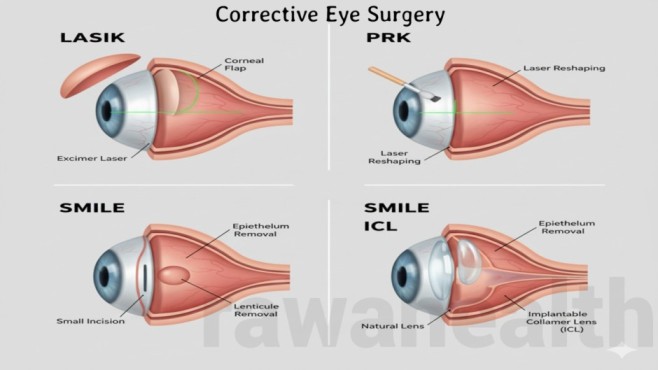
1. LASIK (Laser-Assisted In Situ Keratomileusis)
- The most popular form of corrective surgery.
- A surgeon creates a thin corneal flap, then uses a laser to reshape the cornea.
- Corrects myopia, hyperopia, and astigmatism.
- Recovery is fast, often within 24–48 hours.
2. PRK (Photorefractive Keratectomy)
- One of the earliest laser eye surgeries.
- The surgeon removes the outer layer of the cornea (epithelium) before reshaping it with a laser.
- Suitable for patients with thin corneas who are not eligible for LASIK.
- Recovery takes longer—several days to weeks.
3. LASEK (Laser Epithelial Keratomileusis)
- A variation of PRK where the epithelial layer is preserved and repositioned after laser treatment.
- Provides a balance between LASIK and PRK.
- Recovery is slower than LASIK but faster than PRK.
4. SMILE (Small Incision Lenticule Extraction)
- A minimally invasive surgery using a femtosecond laser.
- Removes a small lenticule of corneal tissue through a tiny incision.
- Corrects myopia and astigmatism.
- Provides quick recovery, less dryness, and fewer complications.
5. Implantable Collamer Lens (ICL)
- A corrective lens is implanted inside the eye, working like a permanent contact lens.
- Suitable for people with very high prescriptions or thin corneas.
- Reversible procedure if needed.
6. Refractive Lens Exchange (RLE)
- The natural lens is replaced with an artificial intraocular lens (IOL).
- Commonly recommended for presbyopia or cataracts.
- Provides both vision correction and cataract prevention.
Who Is Eligible for Corrective Eye Surgery?
Not everyone qualifies for these procedures. Surgeons evaluate candidates based on:
- Age: At least 18–21 years old (vision must be stable).
- Stable vision: Prescription should not have changed significantly in the last year.
- Eye health: No severe dry eye, keratoconus, or corneal thinning.
- General health: No uncontrolled diabetes, autoimmune diseases, or pregnancy.
- Corneal thickness: Determines eligibility for LASIK or alternatives like PRK/SMILE.
A thorough eye exam and consultation with a specialist ensure proper eligibility.
Preparing for Corrective Eye Surgery
Preparation is crucial for safety and optimal results. Patients usually follow these steps:
- Initial Consultation: The surgeon reviews medical history, performs eye scans, and discusses expectations.
- Discontinue Contact Lenses: Soft lenses must be stopped 1 week prior, rigid lenses at least 3 weeks prior.
- Avoid Makeup and Creams: Prevents contamination before surgery.
- Arrange Transportation: Surgery requires someone to drive you home.
- Medical Restrictions: Stop certain medications if advised by the surgeon.
The Corrective Eye Surgery Procedure
Although techniques vary, most surgeries follow a similar process:
- Anesthetic Drops: The surgeon numbs the eyes with special drops.
- Eye Stabilization: A device keeps the eye still during surgery.
- Reshaping or Implanting:
- In LASIK, a flap is created and reshaped with a laser.
- In SMILE, a laser removes a tiny lenticule.
- In ICL, a lens is implanted.
- Completion: The flap is replaced or the incision heals naturally without stitches.
The entire procedure usually takes 15–30 minutes per eye, and patients go home the same day.
Recovery After Corrective Eye Surgery
Recovery differs based on the type of surgery.
- LASIK: Most patients return to normal activities within 1–2 days.
- PRK/LASEK: Recovery takes 1–2 weeks due to epithelial healing.
- SMILE: Healing is quick, often within 2–4 days.
- ICL/RLE: Vision stabilizes within a week.
Post-Surgery Care Tips
- Use prescribed eye drops to prevent infection and dryness.
- Avoid rubbing the eyes.
- Protect eyes from dust, smoke, and bright sunlight.
- Avoid swimming or makeup for at least 2 weeks.
- Attend all follow-up appointments.
Benefits of Corrective Eye Surgery
Corrective eye surgery provides multiple advantages:
- Clear, sharp vision without glasses or contacts.
- Quick recovery for most procedures.
- Long-lasting or permanent results.
- Improved confidence and lifestyle freedom.
- Better performance in sports and outdoor activities.
Risks and Possible Complications
Although modern eye surgery is safe, risks exist:
- Dry eyes
- Glare or halos at night
- Overcorrection or undercorrection
- Infection or inflammation
- Rare loss of vision
Choosing an experienced surgeon reduces these risks significantly.
Long-Term Outlook and Results
Most patients enjoy permanent improvements, although minor changes may occur with age. For example, presbyopia (age-related near vision decline) can still develop after LASIK or SMILE, but procedures like RLE can address it.
Lifestyle adjustments like protecting eyes from UV rays, maintaining general health, and going for annual check-ups extend the benefits.
Corrective Eye Surgery Cost in India
India offers high-quality corrective eye surgery at affordable prices compared to Western countries. Costs vary depending on the procedure, surgeon’s expertise, and hospital facilities.
| Type of Surgery | Average Cost (USD) |
|---|---|
| LASIK | $800 – $1,500 |
| PRK / LASEK | $700 – $1,200 |
| SMILE | $1,200 – $2,000 |
| Implantable Collamer Lens (ICL) | $2,000 – $3,500 |
| Refractive Lens Exchange (RLE) | $2,500 – $4,000 |
Lifestyle After Corrective Eye Surgery
Corrective eye surgery provides freedom, but patients should maintain healthy habits:
- Follow a balanced diet rich in vitamins A, C, and E for eye health.
- Use sunglasses outdoors.
- Limit screen time or use protective lenses when necessary.
- Sleep well to allow natural healing.
These practices enhance both vision and overall well-being.
Final Thoughts
Corrective eye surgery represents one of the most effective, life-changing advancements in modern medicine. With multiple procedures available—LASIK, PRK, LASEK, SMILE, ICL, and RLE—patients can choose a treatment tailored to their needs. These surgeries offer clear, lasting vision, improved lifestyle, and greater confidence.
India provides world-class facilities and expert surgeons at affordable prices, making it an attractive destination for international patients.
If you are considering corrective eye surgery, consult a qualified ophthalmologist, discuss your expectations, and take the first step toward a life free from glasses and contact lenses.
Our Step-by-Step Process – How We Work
- Initial Consultation: Understand medical history, concerns, and goals for personalized guidance.
- Personalized Treatment Plan: Customized plan with recommended treatment, costs, and timeline.
- Travel & Preparation: Visa, airport transfers, accommodation, and language support.
- Scheduling & Procedure: Treatment at top hospitals with experienced doctors using advanced technology.
- Aftercare & Follow-Up: Nursing care, follow-ups, and continuous support for smooth recovery.
Why Patients Choose India for Medical Treatment
- Expert Doctors & Specialists: Highly skilled, internationally trained doctors handle advanced procedures and complex surgeries.
- State-of-the-Art Hospitals: Modern hospitals with latest technology and international accreditations ensure world-class treatment.
- Affordable Costs: Medical care in India is 30%–70% cheaper than in Western countries without compromising quality.
- Quick Access: Minimal waiting times allow patients to get treated promptly.
- End-to-End Support: Visa, airport transfers, accommodation, language translation, and post-treatment follow-up provided.
- High Success Rates: Proven track record in surgeries, transplants, and advanced treatments.
- Personalized Care: Individual attention ensures a smooth, safe, and comfortable medical journey.
Get Started with Rawa Health Services
- If you’re considering treatment in India, Rawa Health Services will guide you every step of the way:
- ✅ Free Pre-Surgery Consultation
✅ Doctor & Hospital Appointment
✅ Visa & Travel Assistance
✅ Airport Pickup & Accommodation
✅ Post-Treatment Support
✅ Multilingual Translators for Your Native Language - 📞 Call/WhatsApp: +91-9990978550
📧 Email: rawahealthservices@gmail.com